Lisez votre miel :Read your honey:
Nous préférons vous montrer plutôt que vous convaincre. Le miel Louvila est testé avant de quitter le Kongo Central, et notre premier lot a été lu grain par grain par un laboratoire pollinique indépendant. Ci-dessous : ce que disent les instruments, de quel lot ils parlent, et les personnes qui prennent les mesures.We would rather show you than tell you. Louvila Honey is tested before it leaves Kongo Central, and our first lot was read grain by grain by an independent pollen laboratory. Below: what the instruments say, which lot they say it about, and the people who take the readings.
Trois lots de la première récolte, printemps 2026, par couleur sur l’échelle PfundThree lots from the first harvest, spring 2026, by colour on the Pfund scale
|
Lot I
Ambré, Pfund 86Amber, Pfund 86
519,000
grains / ml
Parasolier, avec mimosa et autres fleurs de la forêt.Umbrella tree, with mimosa and other forest blossom.
|
Lot II
Ambre clair, Pfund 77Light amber, Pfund 77
170,000
grains / ml
Parasolier, avec acacia et mimosa.Umbrella tree, with acacia and mimosa.
|
Lot III
Ambre clair, Pfund 58Light amber, Pfund 58
680,000
grains / ml
Presque exclusivement parasolier.Almost entirely umbrella tree.
|
Les nuances suivent la mesure Pfund ; un écran n’est pas un laboratoire. Le lot I est le premier lot du producteur du miel de votre pot.The swatches follow the Pfund reading; a screen is not a laboratory. Lot I is the first lot from the producer of the honey in your jar.
|
ContrôléScreened
Aucun résidu de pesticide détecté lors d’un criblage indépendant d’AGQ Labs USA sur notre premier lot, rapport AL-26/094646, avril 2026.No pesticide residues detected in an independent AGQ Labs USA screen of our first lot, report AL-26/094646, April 2026.
|
AnalyséAnalyzed
Pollen lu par un laboratoire indépendant, le PaleoResearch Institute, sur notre premier lot, même producteur, même forêt. Rapport 26-002, mai 2026.Pollen read by an independent laboratory, PaleoResearch Institute, on our first lot from the same producer and the same forest. Report 26-002, May 2026.
|
TraçableTraceable
Chaque pot remonte à un seul lot de forêt, numéroté chez le producteur, scellé avant de quitter Kinshasa, codé jusqu’au rayon.Each jar traces to a single forest lot, numbered at the producer’s, sealed before it leaves Kinshasa, coded to the shelf.
|
Qui a fait les mesuresWho did the reading
Le PaleoResearch Institute, à Golden dans le Colorado, lit le pollen depuis 1972. Son laboratoire a compté les grains de nos trois lots de première récolte, mesuré leur couleur sur l’échelle Pfund et nommé les arbres qui se trouvent derrière. Rapport technique 26-002, mai 2026.PaleoResearch Institute, in Golden, Colorado, has read pollen since 1972. Its laboratory counted the grains in our three first-harvest lots, measured their colour on the Pfund scale and named the trees behind them. Technical Report 26-002, May 2026.
AGQ Labs USA, à Oxnard en Californie, laboratoire accrédité ISO/IEC 17025, a criblé notre premier lot pour près de six cents résidus de pesticides par GC-MS/MS et LC-MS/MS, jusqu’à 0,01 mg/kg. Aucun n’a été détecté. Rapport AL-26/094646, 28 avril 2026.AGQ Labs USA, in Oxnard, California, an ISO/IEC 17025 accredited laboratory, screened our first lot for close to six hundred pesticide residues by GC-MS/MS and LC-MS/MS, down to 0.01 mg/kg. None was detected. Report AL-26/094646, 28 April 2026.
Ce que dit la couleurWhat the colour tells you

Le miel Louvila à la lumière. Central Park, New York, août 2026.Louvila Honey in the light. Central Park, New York, August 2026.
Le miel prend sa couleur des fleurs que les abeilles ont travaillées cette saison-là. À la lumière, cette récolte est ambrée : claire dans la cuillère, plus profonde dans le pot. Elle changera avec la floraison, et nous la laisserons changer. La couleur est la signature d’un millésime, pas une note.Honey takes its colour from the flowers the bees worked that season. Held to the light, this harvest reads amber: bright in the spoon, deeper in the jar. It will change with the bloom, and we will let it. Colour is the signature of a vintage, not a grade.
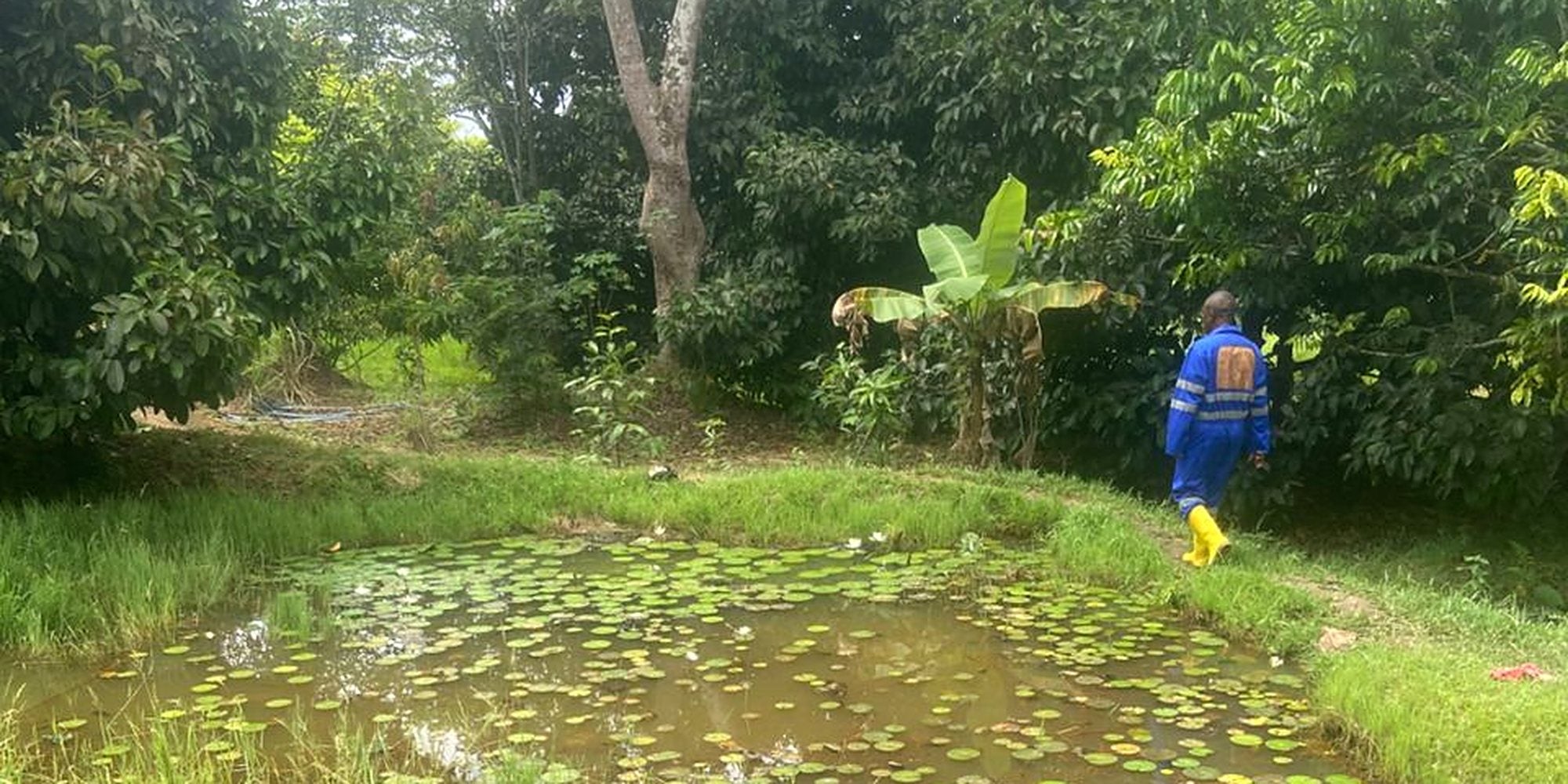
Popol, ingénieur agronome et superviseur qualité et production, au bord de l’eau, en chemin vers les ruches. Forêt du Kongo Central.Popol, agronomist and our quality and production supervisor at the water’s edge, on the way to the hives, Kongo Central Forest.
La forêt qui le façonneThe forest that makes it
La profondeur du miel Louvila vient des forêts sauvages du Kongo Central et du parasolier, le musanga, qui ouvre leurs clairières. Autour de lui poussent l’acacia, l’albizia et le mimosa, et une multitude d’espèces qu’aucune plantation ne réunirait jamais. C’est ce mélange, et les sols minéraux qui le portent, qui donnent au miel son ambre et sa longue finale. Les parasoliers sont coupés pour le charbon de bois, et les abeilles ont besoin d’arbres. Garder la forêt debout n’est pas une cause annexe ici. C’est ce qui permet à ce miel de continuer d’exister.The depth of Louvila Honey comes from the wild forests of Kongo Central and from the umbrella tree, the musanga, that pioneers their clearings. Around it grow acacia, albizia and mimosa, and a scatter of species no plantation would ever put side by side. It is that mix, and the mineral soils beneath it, that gives the honey its amber and its long, savoury finish. Umbrella trees are cut for charcoal, and bees need trees. Keeping the forest standing is not a side cause here. It is how this honey continues to exist.
La forêt en chiffresThe forest in numbers
Le bassin du Congo est la deuxième forêt tropicale de la planète, après l’Amazonie. Elle s’étend sur six pays, et quelque 60 millions de personnes en dépendent pour se nourrir, se soigner et s’abriter. [1]The Congo Basin is the second-largest tropical forest on Earth, after the Amazon. It stretches across six countries, and some 60 million people depend on it for food, medicine and shelter. [1]
La République démocratique du Congo en détient la plus grande part : plus de 130 millions d’hectares de forêt tropicale, soit près des deux tiers du pays. [2]The Democratic Republic of Congo holds the largest share of it: more than 130 million hectares of tropical forest, covering about two thirds of the country. [2]
Le Kongo Central est la province la plus à l’ouest du pays, là où la forêt du bassin s’avance vers l’Atlantique et s’imbrique dans la savane le long des vallées. La réserve de biosphère de Luki, à 120 kilomètres de la côte, protège 33 800 hectares de cette forêt depuis 1976. [3]Kongo Central is the country’s westernmost province, where the basin’s forest reaches toward the Atlantic and interlocks with savanna along the river valleys. The Luki Biosphere Reserve, 120 kilometres from the coast, has protected 33,800 hectares of that rainforest since 1976. [3]
La terre est généreuse, dessous comme dessus. Le pays extrait environ les trois quarts du cobalt mondial et se place deuxième pour le cuivre et pour le diamant industriel. [4] Il compte aussi quelque 80 millions d’hectares de terres arables, dont un dixième seulement est cultivé. [5] Au Kongo Central, cette générosité est du genre vivant : le même sol porte les manguiers, avocatiers et safoutiers des villages et les parasoliers, acacias et albizias qui remplissent les ruches.The ground is generous, below and above. The country mines about three quarters of the world’s cobalt and ranks second for copper and for industrial diamonds. [4] It also counts some 80 million hectares of arable land, and only a tenth of it is farmed. [5] In Kongo Central that generosity is the living kind: the same ground grows the mango, avocado and safou of the villages and the umbrella tree, acacia and albizia that fill the hives.
Comment la forêt nourrit les abeillesHow the forest feeds the bees
Le parasolier est le premier arbre à revenir après une clairière, et il donne aux abeilles leur nectar le plus fidèle. Il est la base de chaque lot que nous avons fait lire, 45 à 91 pour cent du pollen. Autour de lui, l’albizia fleurit en saison sèche, de septembre à novembre, quand presque rien d’autre ne fleurit ; l’acacia suit son propre calendrier ; le manguier, l’avocatier et le safoutier fleurissent de décembre à mars. Les abeilles passent de l’un à l’autre, et le pot porte l’année.The umbrella tree is the first tree back after a clearing, and it gives the bees their most dependable nectar. It is the base of every lot we have read, 45 to 91 percent of the pollen. Around it, albizia blooms in the dry season, September to November, when little else does; acacia keeps its own calendar; mango, avocado and safou flower from December to March. The bees move from one to the next, and the jar carries the year.

Une ruche en lisière de forêt, Kongo Central. Photographie prise sur place.A hive at the forest edge, Kongo Central. Photographed on site.
Garder la forêt deboutKeeping the forest standing
Autour de la forêt, un arbre vaut souvent plus coupé que debout, parce que le charbon de bois est ce qui fait cuire le dîner à Kinshasa : plus de neuf Congolais sur dix n’ont pas d’électricité et cuisinent au bois ou au charbon. Nous travaillons dans l’autre sens, avec le laboratoire qui lit notre miel : un revenu décent grâce à un miel haut de gamme, pour qu’un apiculteur n’ait jamais à choisir entre la forêt et sa famille. Le plan est concret. Garder les parasoliers, qui donnent la miellée de base. Planter acacias et albizias là où la forêt rencontre la savane. Ajouter manguiers, avocatiers et safoutiers pour un second revenu. Lire le miel à chaque saison, pour que la forêt se voie dans le pot. Chaque pot paie les apiculteurs qui gardent cette forêt debout.Around the forest, a tree is often worth more cut than standing, because charcoal is what cooks dinner in Kinshasa: more than nine in ten Congolese have no electricity and cook on wood or charcoal. We are working the other way round, with the laboratory that reads our honey: a living wage from premium honey, so that a beekeeper never has to choose between the forest and the family. The plan is practical. Keep the umbrella trees that give the base flow. Plant acacia and albizia where the woodland meets the savanna. Add mango, avocado and safou for a second income. Read the honey each season, so the forest shows up in the jar. Every jar pays the beekeepers who keep this forest standing.

Popol, ingénieur agronome, près d’une ruche en lisière de forêt. Kongo Central.Popol, agronomist, beside a hive at the forest edge. Kongo Central.
Monielo, sur le terrainMonielo, on the ground
Monielo est l’association congolaise avec laquelle nous travaillons à l’origine. Elle réunit les familles d’apiculteurs, rassemble la récolte lot par lot, tient les registres qui permettent de remonter d’un pot à une seule forêt, et gère les documents qui permettent au miel de voyager. Une part de chaque lot revient, à travers Monielo, aux communautés autour de la forêt et à la replantation des arbres dont dépendent les abeilles.Monielo is the Congolese association we work with at origin. It brings the beekeeping families together, gathers the harvest lot by lot, keeps the records that let a jar be traced back to a single forest, and carries the paperwork that lets the honey travel. A share of every lot goes back through Monielo to the communities around the forest, and to replanting the trees the bees depend on.
Des pans entiers du Kongo Central sont à l’écart des routes. Le dernier tronçon jusqu’aux ruches se fait à pied ou à l’arrière d’une moto, sur des pistes rouges dans les hautes herbes. Obed a été scolarisé grâce à un parrainage Monielo. Aujourd’hui il tient notre logistique à Kinshasa et porte les échantillons du terrain jusqu’à l’aéroport et à la poste, pot après pot.Parts of Kongo Central are untouched by roads. The last stretch to the hives is on foot or on the back of a motorcycle, on red tracks through the tall grass. Obed went to school on a Monielo sponsorship. Today he runs our logistics in Kinshasa and carries the samples from the field to the airport and the post office, jar by jar.

Sur la piste des ruches, Kongo Central, mars 2026. Obed est à l’arrière.On the track to the hives, Kongo Central, March 2026. Obed rides pillion.
Dolce a elle aussi été scolarisée grâce à Monielo. Elle tient la caisse à Kinshasa, aide à faire tourner les opérations locales, et quand le miel est arrivé de la forêt en août, c’est elle qui l’a réceptionné et a signé.Dolce went to school on a Monielo sponsorship too. She keeps the cash desk in Kinshasa, helps run the local operations, and when the honey came in from the forest in August she was the one who received it and signed for it.

Dolce, en tenue d’apicultrice aux ruches. Kongo Central.Dolce, suited up at the hives. Kongo Central.
Numéroté, fermé, scelléNumbered, closed, sealed
Notre règle : un bidon neuf et alimentaire à chaque remplissage, utilisé une seule fois. Chacun est étiqueté et numéroté à la main là où il est rempli, code du lot et numéro de bidon, et les bidons sont comptés et signés à chaque passage de main, du sol du producteur jusqu’à l’entrepôt de Kinshasa. Avant l’enlèvement pour le vol vers New York, chaque bidon reçoit un scellé numéroté, et les scellés sont photographiés. Trois échantillons témoins de 250 ml sont prélevés chez le producteur et conservés à part.Our rule is a new food-grade jerrican for every fill, used once. Each one is labelled and numbered by hand where it is filled, lot code and jerrican number, and the jerricans are counted and signed for at each handover, from the producer’s floor to the warehouse in Kinshasa. Before pickup for the flight to New York, each jerrican gets a numbered tamper seal, and the seals are photographed. Three 250 ml retention samples are drawn at the producer’s and kept apart.

Scellé 007632 sur un bidon avant l’enlèvement. Kinshasa, août 2026.Tamper seal 007632 on a jerrican before pickup. Kinshasa, August 2026.

Les bidons, numérotés et scellés, avant l’enlèvement. Kinshasa, août 2026.The jerricans, numbered and sealed, before pickup. Kinshasa, August 2026.

Échantillons témoins S1 à S3, 250 ml chacun, prélevés chez le producteur. Kongo Central, août 2026.Retention samples S1 to S3, 250 ml each, drawn at the producer’s. Kongo Central, August 2026.
La boucle est boucléeThe circle closes
Ketshia a été scolarisée grâce à un parrainage Monielo. Aujourd’hui, agronome et coordinatrice de mission et traçabilité, c’est elle qui contrôle chaque bidon de miel Louvila avant son départ du Kongo Central : la mesure d’humidité, les numéros, l’étiquette qui relie chaque lot à la forêt dont il vient. L’association qui a payé ses études travaille désormais aux côtés de l’entreprise que son soin rend possible. Rien de ce qui se trouve dans votre pot ne vous parvient sans être passé d’abord entre ses mains.Ketshia went to school on a Monielo sponsorship. Today, as an agronomist and our mission and traceability coordinator, she is the one who checks every jerrican of Louvila Honey before it leaves Kongo Central: the moisture reading, the numbers, the label that ties each lot back to the forest it came from. The association that paid for her education now works alongside the company her care makes possible. Nothing in your jar reached you without passing her hands first.

Ketshia étiquette les bidons avant leur départ. Kongo Central, août 2026.Ketshia labels the jerricans before they leave. Kongo Central, August 2026.
Chaque bidon est mesuré avant d’être fermé et le chiffre est écrit à la main : 16 % d’humidité sur cette récolte, assez sec pour voyager et pour se conserver. Ce ne sont pas des audits faits pour obtenir un certificat. Ce sont deux personnes, dans une pièce du Kongo Central, qui décident si un lot est assez bon pour porter notre nom.Every jerrican is read before it is closed and the number is written down by hand: 16% moisture on this harvest, dry enough to travel and to keep. These are not audits done for a certificate. They are two people, in a room in Kongo Central, deciding whether a lot is good enough to carry our name.
Du Kongo Central à Central ParkFrom Kongo Central to Central Park
Cette page est la preuve. L’histoire se raconte dans La Traversée, nos lettres du Kongo Central à Central Park, un chapitre à la fois.This page is the proof. The story is told in The Crossing, our letters from Kongo Central to Central Park, one chapter at a time.

Le miel Louvila, forêt du Kongo Central. Central Park, New York, août 2026.Louvila Honey, Kongo Central Forest. Central Park, New York, August 2026.
SourcesSources
[1] WWF, Congo Basin (worldwildlife.org); UNEP, Critical ecosystems: Congo Basin peatlands, 27 February 2023. [2] Central African Forest Initiative (CAFI), Democratic Republic of the Congo; Global Forest Watch, DRC dashboard, natural forest 2020; FAO forest area cited by UNEP-GRID. [3] UNESCO Man and the Biosphere Programme, Luki Biosphere Reserve; One Earth, Western Congolian forest-savanna ecoregion. [4] U.S. Geological Survey, Mineral Commodity Summaries 2026 (cobalt); USGS National Minerals Information Center, Congo (Kinshasa), 2024 data (copper, diamond). [5] Embassy of the Democratic Republic of the Congo, Washington, Agriculture; PaleoResearch Institute, Recommended Trees and Understory Plants, May 2026. [6] PaleoResearch Institute, Technical Report 26-002 (H26-002), May 2026; H26-002 client spreadsheet. [7] AGQ Labs USA, analytical report AL-26/094646, 28 April 2026. [8] Maison Louvila and Monielo field records, harvest 2026: Form A (7 August 2026), Form D (8 August 2026).